Barricades on the Bridge of Hope

Available FREE on iTunes and Podbean

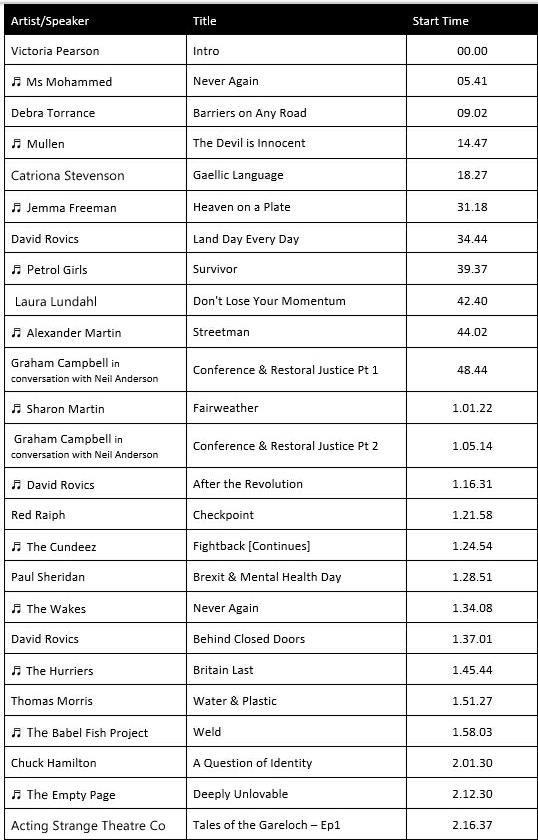
On this episode of Ungagged, introduced by Victoria Pearson, and edited by Neil Anderson, the collective are inspired by the theme “Barricades on the Bridge of Hope” and as usual, have interpreted that from a variety of left perspectives.

Red Raiph will be talking about Checkpoint Charlie, Paul Sheridan will be discussing both World Mental Health Day and the Brexit border situation, and Thomas Morris will be joining us from his travels to talk about water and plastic.

Debra Torrance will be telling us about her trip to the SNP conference and accessibility, and  Cllr Graham Campbell will be in conversation with Neil Anderson also about the SNP conference, specifically Graham’s fringe meeting on ‘Brexit, A Better Way, as well as Glasgow University reparative justice and their involvement in slavery related businesses.

Catriona Stevenson  will be talking about the Gaellic language, Laura Lundahl will be warning us not to lose momentum, and reminding us progress can be a barricade to progress, and of course we will hear from Chuck Hamilton, pondering a question of identity.

On this episode we’ll also share David Rovics podcast- This week with David Rovics, where he talks Palestinian protests and police numbers in Seattle in the 80s, and treats us to two original songs, and for you fiction lovers we will be featuring part one of  “a murderous story of ordinary irradiated folk and peace in a Scottish village in an alternative reality” – Tales of the Gareloch by Acting Strange Theatre Company…

With music from Alexander Martin, David Rovics, Sharon Martin, Jemma Freeman, Ms Mohammed, Petrol Girls, The Cundeez, The Hurriers, The Wakes, Mullen, The Empty Page, and The Babel Fish Project.

Remember we love hearing what you think, so get yourself over to Facebook, twitter or the comments right here on our website and get yourself ungagged.

If you love what we do, and can spare us some change, our collection tin is at PayPal.me/ungaggedleft. We are a not for profit collective, and we rely on your donations help us meet our hosting and equipment costs as well as fund our solidarity letter writing campaigns, and foodbank donations.

Dancing Queen


Theresa May danced on stage at the Tory conference, clearly relishing the opportunity to make a bit of a joke out of her recent Africa dance exhibition. If everyone else at the conservative conference is auditioning for the prime minister’s job, is she auditioning for the BBC’s Strictly?

It’s nice to know that our female PM can be so gallus when there is so much work to do. Brexit is looming and we are no closer to an actual deal, the options laid out by the ministers in charge have been confusing and even contradictory. How can we “take back control of our borders” and “not have a hard Irish border”? 

This is the trouble with trying to satisfy dedicated brexit supporters and demands for less immigration but having to deal with actual reality. Immigration is so vital to our economy that recently stories of workers departing back to home nations have left various industries across the board short staffed.  


It’s also contradictory to say the government “respects all British citizens” while still deporting some of the Windrush generation and denying European migrants (spouses and parents of British born citizens) right to stay when they have lived, worked and made their home here for decades.


I’m pleased that a female politician has risen to such career heights that she can swagger on stage at her party conference whilst knowing she’s implemented policies that have literally killed people*. 

*(link cw: suicide)

Also it’s nice to know she can walk in such a flamboyant fashion whilst some of her policy changes mean some people who can’t walk so well have had their motability vehicles taken away from them.


Recently I have been rewatching The Thick of It. I’m trying so hard to not write with Malcolm Tucker’s vernacular coming out. The Conservative party are so full of it, they praise the NHS whilst privatisation is happening in England as they speak. 

Duplicity is a political tactic, to appeal only to some and have “the right sort”, those earning enough and help only those who they deem deserving.


by Debra Torrance

You can read more Ungagged Writing here or listen to a range of left voices on our podcast

Step Aside, Brother

Available FREE on iTunes and Podbean

This unintentionally woman-heavy episode of Ungagged, introduced by Neil Anderson,  is themed around “Step Aside Brother,” but of course we are Ungagged, so not all of us have kept to the theme.

Thomas Morris will be talking about how sometimes brothers don’t step aside once they’ve got what they want, Chuck Hamilton will discuss bi-erasure, neoliberalism, and the importance of slaying your gods, and Damanvir Kaur will give us an update Jagtar Singh Johal, the Scot imprisoned in an Indian jail.

Debra Torrance will be joining us twice – once to deliver a piece on behalf of the showmen at Feltham, who feel silenced by their councillor as their home is threatened, and then again with a piece of her own, asking how many people are reached and persuaded by shouty men yelling slogans into a microphone.

Em Dehaney will be talking about gendered language, and how it subtly shapes our perceptions of feminism, Julie will be along to talk about representation for women and young people within the Yes Movement, and Ruth Hopkins will be talking about Kavanaugh.

Laura Lundahl will be talking about why developed countries need to step aside in developing ones, Catriona Stevenson will be talking about land reform, Victoria Pearson will be sharing a poem called Stand Aside Brother, that she wrote for this episode, and our Raiph will be wondering if Wee Vinny is a spy…

With music from The Franklys, Alexander Martin, Argonaut, The Babel Fish Project, Jackal Trades, LUV DOT GOV, Precious McKenzie, Sharon Martin, Steve McAuliffe & The Mighty Ur, The Empty Page, The Menstural Cramps and David Rovics.


Agree or disagree, love us or hate us, we always love to hear from you, so get yourself Ungagged on Facebook, Twitter, or here on our website, where you can find all of our old pods and a whole stack of writing from a range of left voices -from anarchists to democratic socialists and everything in between.


If you love what we do and can spare some change to keep us going, our collection tin is at PayPal.me/ungaggedleft – every penny helps our volunteers buy essential equipment, meet our hosting fees, and fund our charity campaigns, for example donating to foodbanks in need, and supporting and writing to political prisoners


Stand Aside, Brother

“All men are trash”
She tweets, in her rage
As yet more news shows
Life for women’s a cage.

“Not all men,” you object,
Because you’re a nice guy
And anyway 99%
of rape accusations are lies.

“We don’t hate women!
Don’t we have mothers?”
They yell at the victims,
Instead of checking their brothers.

I don’t need you telling me
I shouldn’t be mad
Double thinking that “equality’s
good but feminism is bad”

We don’t want special treatment
We just want to be free.
Rage at men giving you a bad name
Instead of lecturing me

Your reputation is tarnished
Not by me, but your brother,
Call out his behaviour,
Treat us as you do each other.

All men are not trash,
This much we see;
A dog has four legs,
Although some dogs have three.

I don’t need a leg up,
Don’t want more than I’m due,
Just stand aside, brother,
Let a sister get through.


This poem was written for the Step Aside, Brother Podcast


By Victoria Pearson


You can read more Ungagged Writing here or listen to a range of left views on our podcast 


Why People Need to Stop Claiming Indyref Was Rigged


The past few weeks have seen a recurrence on social media of conspiracy theories suggesting the independence referendum was rigged. The fact that these continue to circulate four years after the event is worrying.


In my view some Yes supporters will risk undermining the next independence referendum if they keep spreading false stories about the unreliability of the electoral system. I will set out why in this article but first I want to restate that the indyref really wasn’t rigged.


There is no evidence the administration of the referendum was anything other than proper and it is unfair to the thousands of Yes campaigners who acted as polling and counting agents, as well as to the election officials who managed the process, to suggest otherwise.


Indyref conspiracy theories generally revolve around aspects of the voting and counting process which the conspiracy theorists and their advocates do not understand. What is most concerning, however, is the way some cling to the belief that the referendum process was manipulated even when specific allegations are debunked by those who were there.


Elections and referendums are co-produced by election officials and political volunteers, with the assistance of the police. The system is tested and scrutinised intensely from every angle by polling and counting agents – including agents appointed to scrutinise postal vote openings – to ensure it is a free and fair process. And it is a free and fair process. Of course issues arise and vigilance is required to prevent fraud. But those who administer the system do so fairly and it is wrong to suggest otherwise without a shred of proof.


Yet we still see demands for international monitors to oversee the next referendum. What could external monitors, watching a system that is unfamiliar to them, pick up that thousands of experienced and dedicated Yes activists would miss? There is no aspect of the process which could be scrutinised by external monitors that cannot already be scrutinised by agents appointed by registered campaign groups, many of whom have decades of experience as polling or counting agents under their belts.
Falsely claiming that our electoral system is corrupt is not just reprehensible, it is politically inept and self-defeating.


The 2014 campaign saw an unprecedented level of public engagement in the democratic process, reflected in the incredible turnout. The campaign was described as a festival of democracy and an exemplar of how a referendum should be run – and rightly so. No amount of disappointment in the result should tarnish the campaign or destroy trust in the robust democratic process which underpinned it. That can only benefit our opponents.


After all, why would voters who were crushed by the result in 2014 be motivated to invest their hopes again in a process which Yes supporters claim is secretly controlled by the British State and rigged to ensure that Yes can’t win? What’s the point in voting, when your own side tell you it’s all a fix?


This is the fundamental issue that people like me find so frustrating. These conspiracy theories – if they continue to be a feature of online campaigning – combined with the impact of individual voter registration, could create a recipe to suppress the Yes vote in the next referendum. This is a risk in some areas where Yes won the vote in 2014 and where we are going to have to work extremely hard to get the same level of voter registration and turnout.


Conspiracy theories around postal votes in particular are highly counter-productive. Postal voters are more likely to vote than those who vote in person. It makes no sense therefore to undermine trust in a system which has been strengthened specifically to combat fraud. Rather than dissuading independence supporters from applying for a postal vote we should be trying to get our supporters onto a postal vote to maximise our turnout.
The last Westminster election confirmed that SNP – and by extension Yes – voters are less “sticky” than we would like. This is not surprising given many of them were galvanised by the referendum and may have been fairly disinterested in politics before that. While we can plan to ensure that the next referendum will galvanise them in a similar way, we cannot assume that. This makes it imperative that we do all we can to make sure independence supporters actually vote.


But as well as securing and energising our base, the focus of the Yes campaign, if it is to be successful, has to be about building support. It has to be about reaching out to and persuading undecided and soft No voters to consider independence. And it has to look forwards, not backwards; outwards, not inwards. Sharing conspiracy theories will not help us to do that, it will have the opposite effect.


Having said all this, I do understand why Yes supporters fall into the conspiracy trap. As frustrating as their behaviour is, I share their disappointment and recognise the feeling that things are stacked against us, making winning all the harder. All long-standing members of the SNP will recognise that feeling. But it needs to be shaken off.


The experience of being in the SNP prior to 2007 was mainly about losing. Believing that we could win took a conscious effort of will and a complete reconsideration of how we campaigned. This was more difficult than people might imagine. There is such a thing as a loser’s mindset in politics and you develop it without even noticing. The best way to overcome it is to take a step back, look at where you are and what you need to do to win.


At this point in time we do not have a majority for Yes. In order to get one we need to persuade people who voted Yes in 2014 to commit to doing so again and persuade a significant number of people who voted No to change their minds. That’s our task. Whatever we do should be working towards that end – and that means ditching the comfort blanket of conspiracy theories and going forward with confidence that our case is strong and that we can win.

By Mhairi Hunter


You can read more from the collective here, or listen to a range of left views on our podcast

Four Years Ago…

Four years ago, today, reality collided into our very beings as we realised that despite all the canvassing, meetings and conversations, most Scottish voters had preferred to stay part of the United Kingdom than for Scotland to become an independent country. Despite the grief felt by many, there was a genuine optimism that a new kind of politics had been forged throughout the referendum campaign. I for one was very proud to play a role, working with people of all parties and none to put across an alternative vision for the future of Scotland.


In the weeks and months following the referendum, this hope and optimism turned for many into an adoption of different colours and fierce attacks at any criticisms of roles played in the referendum. Some like myself, foolishly thought real change was possible in helping to evolve and enhance other pro-independence parties to in part remove the stigma that independence was ‘all about the SNP’ While members of smaller pro independence parties were asked to lend their vote in General Elections on the vague assurances that it would be repaid in the PR votes of Holyrood.

When they never came further divide was created. Added to that those who dared to ask for more from a Scottish Government who had pledged in 2015 to end austerity politics were hounded, tarred as unionists in disguise, suddenly the unspoken common charter of decency and genuine debate was torn apart. In what may be an unpopular opinion, the SNP must shoulder some of this blame. In seeking to maintain their ascendancy they have allowed this to tarnish the positive and inviting atmosphere the yes campaign had created. In short, they have placed party power ahead of any chance to improve the route to independence.


Further proof in this was in their attacks on Jeremy Corbyn. Here at last there was a Labour leader who shared the vision of a society many in the yes campaign had espoused, yet rather than seek to work with him or to convince his many supporters in Scotland that independence was the best route for this society in both Scotland and ergo through successful implementation in the RoUK also. They have instead joined in with the Tory party and media attacks on him and those with an opportunity to transform the Labour Party into the socially just party it was created to be.


To be fair to the SNP their attacks and power grabs are understandable to a degree in that they must retain power in Holyrood to have another opportunity at an independence referendum, however they have by proxy set off the more ardent fringe members of the yes campaign to act in a way that has seriously tarnished not only the legacy of the yes campaign but also future opportunities for a successful referendum result.


It is however not too late to rescue the situation. The re-emergence of local yes groups is a positive step in moving the campaign away from the fringes of social media. The real positivity and creativity of the last campaign came from these groups in conjunction with the smaller yes parties and groups such as Labour for Independence, RIC, BFI, and Women for Independence. While the Common Weal has been in place these last four years and have produced a power of positive alternatives for policy within an independent Scotland, they have with respect fallen into the same trap that many local yes groups had last time out.


Far too often meetings and events were arranged that were preaching to the converted. A reality must set in that if we are to achieve a yes vote beyond 50% we must reach out to those who voted no the last time. Offer to debate them, attend the same groups & projects within the community and engage with them on a more personal basis. I for one am guilty of not reaching out as much as I could to no voters in these last four years.


Finally, Labour are not the enemy, most decisions in the party are made by a select few within the party, most members whether they will agree with a yes vote or not will engage and debate. One of the biggest failings in the last campaign was finding comfort in calling Labour red Tories when really, they just had a differing point of view.


There is still an opportunity to begin to rebuild the bridges which have fragmented the Yes Campaign, I’m sure some will accuse this article, by criticising the SNP, of further fracturing the movement. I respectfully disagree. As we so often repeated during the last referendum, yes isn’t about Salmond, or Sturgeon or the SNP, it is about creating a better society. I believe in that better society, I believe that Jeremy Corbyn can deliver that in a Westminster Parliament if given the opportunity, but will he ever get that chance? That’s a case that needs to be made. It won’t be made without engagement of no voters, nor without self-regulating the content we support on social media. It’s time to mend fences and then regardless of yes or no, we will be back on the road to a better nation.


By Allan Grogan

You can read more Ungagged Writing here or hear from a range of left views on our podcast 

Life In The Empire Part 4: Modern Vassal States

A bed for a recovering alcoholic at the inpatient treatment center I work at is comprised of five layers: mattress pad; fitted sheet; flat sheet; blanket; bedspread. Not a single crease can remain on the bedspread once it’s been placed. Hospital corners must adorn the foot of the bed by lifting the mattress itself, gripping a portion of the overhanging sheets about a foot from the end of the bed and draping it onto the top, tucking the remaining material between the lifted portion and the lower edge flat under the mattress, and letting the mattress back down while allowing the raised portion to drift over the side to form the bed’s wings. I’m in the detox hallway preparing one such bed, as even the most far-gone alcoholic who won’t remember their stay here can still appreciate a soft landing pad during the hell of withdrawal, when Sharmini Peries of The Real News Network informs me that Canadian Prime Minister Justin Trudeau announced plans to push back on the Trump Administration’s tariffs against Canada with retaliatory measures of their own. He ends his sentence by reminding the audience that Canadians “will not be pushed around”.

The good prime minister knows worlds more about running a country than I do, and his hospital corners are probably also superior to mine, but this was one of the most laughably empty threats I’ve ever heard in the geopolitical sphere.

The notion that Canada could inflict any meaningful damage to United States commercial interests without suffering massive losses in its own economy ignores a reality the Canadian left warned about decades ago: Canadian export markets depend on U.S. buyers on an overwhelming scale. Almost three-quarters of Canada’s total export markets cited the U.S. as their primary buyer in 2017, and all but three of the top twenty Canadian export industries ship the majority of their product down south. It’s Donald Trump’s sword against Trudeau’s dagger, and while my heart may be in Ottawa for that fight, my money’s staying in Washington D.C. The Canadian left always understood the liability this schematic could create if the U.S. ever chose to leverage this enormous imbalance over the Canadian economy. They called for Canadian industries to diversify their markets and disarm this ticking time bomb. Previous Canadian prime ministers did not heed the warning, and now Trudeau is stuck in the difficult position of lacking the leverage to push back on the coercive tariffs Trump decided to slap on when he cut himself shaving that morning.

History buffs may recognize this relationship. It echoes the vassal states of the bygone colonial era when colonies relied on their mother countries to build and maintain their fundamental economic infrastructure. For all practical purposes, Canada is a 21st century neo-vassal state of its titanic neighbor. It’s been an unspoken reality since the end of the Second World War. But Canada isn’t the only country waking up to this reality; the nations of Europe find themselves in similar identity crises following the U.S.’s withdrawal from the Joint Comprehensive Plan of Action (more commonly known as the Iran Nuclear Deal) and the subsequent sanctions that threaten to close off U.S. markets to any international company that continues to do business in Iran.

The European Union runs a slight trade surplus with the U.S. which increases its potential leverage over that of Canada, but it now faces a crucial decision in its future global trade prospects: capitulate to an arbitrary decision made by the U.S. president, or risk losing access to vital U.S. markets. Similar objections rose across the E.U. when the U.S. Congress passed sanctions on Russia for alleged interference in the 2016 presidential election. E.U. members felt the sanctions would harm their capacities to engage in commerce with Russia, a core trading partner of several E.U. member nations.

The post-Second World War global economic structure has created a string of scenarios in which a single country’s decisions force its allies to comply or else risk potentially catastrophic economic blowback while the country making the decisions faces none of the consequences. German historian Philipp Ther documented the spread of U.S. economic dominance in Europe in his book Europe Since 1989: A History. With the fall of the Berlin Wall and the collapse of Soviet economic models throughout eastern Europe, neoliberal economic philosophy seeped into the consciousness of the former communist states throughout the 1990s. Poland was the first to fall to such influence due to a hyper-inflated currency and obscene amounts of accumulated debt. The former Yugoslavia followed in short succession. The floodgates of free market fetishism burst open from there to infect not just the former communist states but also the welfare states of western Europe. Take a look at the meteoric rise of right-wing nationalism in the United Kingdom, France, Poland, Hungary, Greece, Italy, and so many other nations and you will find yellow brick roads leading back to the twenty-year wreckage of neoliberal policies radiating into these countries from the cancer that is U.S. global economic dominance.

The fallout also spreads into relations between European states. Greece’s 2013 declaration of bankruptcy prompted a series of austerity measures that cut government programs and raided Greek citizens’ retirement funds. International media spun the crisis as a battle between Greece and the French-German coalition tasked with negotiating a settlement to reconstruct the Greek economy. However, as explained by former Greek finance minister Yanis Varoufakis in his book Adults in the Room: My Battle with the European and American Deep Establishment, this was never an accurate depiction. The insistence on austerity measures came not from France or Germany, or even the European Central Bank, but from the mouth of the International Monetary Fund, an institution serving as a group of economic hitmen addicted to slaughtering whole economies. No country exerts more influence over IMF policy than the U.S., and ordinary Europeans act as lightning rods for the whimsical decisions made by American-backed fat cats in suits. Sure, let’s try austerity measures in Greece; see what happens. Not like our retirement pensions are the ones being gutted. And hey, they’ll just blame Germany and France when the deal goes south. The Greek financial crisis was never a matter of France and Germany versus Greece; it was always a product of international private interests serving U.S. goals while turning European nations against each other. A textbook process of privatizing the gains and socializing the losses.

Vassal status extends beyond the economic sphere into military alliances. Donald Trump’s criticism of the North Atlantic Treaty Organization sparked a bizarre infatuation with the conglomerate among the American left. My hot take: NATO is an outdated relic of U.S. imperialism that needs to be dismantled in the interests of maintaining peace across Europe. Confused? Bear with me.

Think about the official NATO military interventions, all of which occurred after the fall of the Warsaw Pact it was created to oppose. What European interests did the 21st century interventions in Afghanistan, Iraq, Somalia, and Libya serve? What country in the NATO alliance benefited from the waves of migrants fleeing the carnage in desperate efforts to reach havens in Europe? Tony Blair talked a big game about the importance of destroying the alleged weapons of mass destruction in Iraq and fractured the U.K.’s relationship with continental Europe in the process, all because then-president George W. Bush told him to. The U.S. couldn’t care less about this blowback; there’s a whole ocean to keep migrants and international tensions at bay. This is another central characteristic of vassal states: the use of military resources for the mother country’s interests regardless of the consequences for those on the frontier.

Like most 21st century mechanisms of colonialism, the vassal status of U.S. allies is not as explicit as the colonies of old. It’s also not as clear-cut as American installation of a series of dictators in the Philippines to crush the rising indigenous socialist movements there or the continued exploitation of Puerto Rico, Samoa, Guam, and other islands as “protectorates” with limited sovereignty. The vassal status of U.S. allies in the Western world sounds outrageous, as how can countries on relatively equal standing be locked in such a dynamic? Answer that yourself by asking what realistic strategy Canada can implement to push back on the Trump administration’s tariffs, or why European governments cannot convince their largest private companies to continue operations in Iran in their efforts to salvage the Iran Nuclear Deal, or why a crash of the U.S. dollar set in motion by greedy halfwits that the U.S. government refuses to prosecute mangles the global economy in a way no other currency can dream about doing. While you’re at it, ask yourself what benefits any European nation reaped from any U.S.-led NATO intervention of the past twenty years, or how escalating tensions with Russia over yet unproven election interference increases safety for any E.U. citizen.

The picture that emerges isn’t a pretty one for any European sovereignty enthusiast; it’s painted with blood on a canvas of skin.

As the world barrels towards a new multi-polar horizon with the rise of emerging markets like China and the formation of Russia, China, and Iran as a new and albeit unstable Eastern Bloc, many in the Western world are also reevaluating their desires to stay hitched to a bloated abusive partner in the United States. The Canadian left’s warnings of the dangers of unilateral dependency on U.S. markets have finally reached a mainstream audience in Canadian politics. China’s explorations into alternatives to U.S. dollar dependency and announcements of possible investment into Iranian markets has encouraged E.U. member states such as Germany to consider shifting their own international commerce towards the new Eastern Bloc. Resistance to military budget expansion among NATO states and the bizarre addition of Colombia to the mix has created skepticism of the alliance’s relevance in a post-Cold War world. It’s high time Canada and the countries of Europe break from their status as neo-vassals serving the interests of the American Empire over their own.

Vassal states have no place in the 21st century world stage.

You can read part 1 of Life in the Empire here,  part 2 here, and part 3 here

By George Collins

You can read more Ungagged Writing here or hear a range of left views on our podcast

The Profit Murders

Scottish Television investigative Reporters have produced a programme, “The Dark Side of Dairy.” For a wee bar of milk chocolate, or milky tea, male calves are put to death almost as soon as they are born. Their lives are almost totally worthless in our for profits capitalist system. Same with eggs. Male birds are worthless, so when they hatch, they are thrown into a grinder for feed.

I find veganism difficult for only two reasons. One when I’m in Northern Ireland, restaurants and cafes rarely have good vegan alternatives. I’m waiting to be offered a cabbage sandwich. And two, if its in the house (I live with an omnivore and a vegetarian) my resolve can melt. I’m getting better at that though.

My veganism is for many reasons. But primarily because with all conscience, I couldn’t kill an animal myself, so I don’t feel anyone should do it on my behalf.

This is the same regarding war. I won’t support anyone sent on my behalf to kill people if I can’t do it myself. And I couldn’t.

I’ve been wrestling with Syria and what is going on there. There are many reasons why a British or American led force to stop Assad and Russia from slaughtering people in Idlib can or can’t be deployed. The left are pretty adamant as a semi cohesive group are against military intervention. But something MORE needs to happen. And those like me on the left, should be talking about it. It’s time to ignore the conspiracy theorists and Assadists.  I feel the left, by almost ignoring the slaughter in Syria (and the Yemen) have shown really, how weak we are. How incohesive we really are. How scared we are in the current onslaught by conspiracy theorists, the alt right and the likes (and how the Venn diagram of these groups, and the left overlap, as Sheridan for example, here in Scotland issues a series of idiot conspiracy theorist tweets and takes ultra capitalist Russian gold with a contract with the propagandist broadcaster, Sputnik).

And worse still, how scared we are of the Puritans on our own side. In my opinion those who wave their analysis like some street corner Preacher points his Bible at passers by, and name call and tell those of us debating and discussing some kind of intervention, “You are supporting Imperialism,” are tacitly supporting the murder of tens of thousands of children, women and men.

The shutting down of conversation about what we as the left should call for, or we as the geo-political entity currently called the UK can do will be a defining moment in 21st century history. This current period will shame the left for decades to come. 

Have I got a solution? No, I haven’t. I don’t know all of the options. As an individual I can do nothing. I cant take up arms, and me boycotting the arms trade in the UK in order to try to stop the state sanctioned murders of Yemini families has no impact. Making statements on social media has absolutely no impact – it only draws the conspiracy theorists, the Vanessa Beeley fanboys and girls and the ultra left manic street preachers. The coalition to stop the war is no longer campaigning to stop war. Only some war. So I feel I am no longer part of a coalition, I am part of a group of people effectively silenced while all around me, for my consumption, people are sacrificed. I am -we are- silenced. We are unable – incapable – of discussions on stopping the war, stopping the state sanctioned murders for profit.

I salve my conscience regarding the meat and dairy trade. I do my best not to take part. But my silence and my fear regarding what is happening in the Yemen, Syria, Palestine and other theatres of war, allows the capitalist forces of the USA, the UK, France, and Russia to slaughter human beings in order for billionaires to create new markets for whatever crap they want us addicted to.

When will I find my voice again? I fear never. Because we are shamed. What can we ever say on a world wide stage that should be taken seriously? We’ve given the stage to Putin, Trump and the corporations they oil the wheels for.

And they gladly send people to slaughter others, because the lives of daughters, sons, mothers, fathers are almost worthless in their profit driven, capitalist system.

By Neil Scott

You can read more Ungagged Writing here or hear a range of left views on our podcast

Brexit Fightback: We must demand a better future

I’ve hesitated to write much about Brexit: there is so much uncertainty, so much chaos. But we on the left need to get ourselves organised, if we want to prevent this chaotic uncertainty from blighting our future for generations to come. I want us to work together to stop Brexit from happening.

Scotland voted remain by a clear majority. As a nation, we understand the importance of being part of something bigger … not in a ‘being shackled to’ sense, but in a sense that while our own small country is beautiful there is a bigger world out there that we want to look out to, not close ourselves down from. I am, unapologetically, an internationalist.

I can’t not mention the disdain with which the UK treats Scotland: SNP parliamentarians being told that suicide was the best option open to them when they were not given a say in changes made to Scotland’s devolution settlement; the wishes of the Scottish Parliament being completely ignored. Westminster is a farce, and it has been for some time. But it is a symbol of just how broken British democracy, is. Without respect for democracy, the UK is well and truly broken.

And this should matter to us. The 2016 EU referendum was called in order to hold the Tory party together. But there was then NO attempt to explain what it would actually mean. We were sold a completely false prospectus by the leave campaigns (still waiting for the £350 million a week for the NHS). There was no attempt to articulate what was good about the EU. No one talked about what sovereignty or “take back control” actually mean. And there was no real opposition to Brexit in Westminster. The Labour Party failed to argue either that that the EU was worth fighting for (given it has secured workers’, women’s, LGBT, environmental and so many other rights, freedom of movement, and a consolidated economic force) or that Brexit was a good idea because the EU is an anti-democratic structure that needs to be defeated in the interests of human and environmental rights.

In Scotland, we have an opportunity to offer something a little bit different to the debate. We are used to talking about politics, about how decisions should be made. We understand, here, that local power and local decision-making matters. So let’s lead the charge against a British Empire 2.0 Brexit!

Because none of the three prospects for Brexit that I think are possible is very palatable.

First, we have Brexit in name only, or BINO. This looks like an EEA sort of relationship that brings with it contributions to the EU budget, requirements to abide by Commission decisions, access to the single market, freedom of movement of people. However, it also means no say in EU policy development and implementation. And it brings with it the very real – and quite terrifying – risk of a right wing rebellion at Brexit denied. I am sure that none of us wants to see the fascism of the far right gain any purchase in our politics … we certainly don’t want a deeply racist anti-immigrant, racist backlash.

Second, we have what we might call Tory Brexiteer Brexit – “Global Britain” – signing trade deals, reorientation away from the EU and towards other markets. But this brings with it a period of deep economic reorganisation once we’ve moved to WTO rules and before we’ve negotiated any other trade deals or relationships. The economy in this context will be low wage, low regulation, no worker protection, increasing inequality (the removal of all social protections) – privatisation and full charging of NHS like US model, privatised education, road user charging, marketisation of all local government services (rubbish collections, environmental wardens, etc.). This is the Jacob Rees Mogg model. If you disliked TTIP, this brings a TTIP with every trade deal, only with even more loss of sovereignty because our negotiating weight is substantially less than that of the EU.

And thirdly, we have what we could call the Jeremy Corbyn model – Britain insulated from the global economy, much less access to global goods, the replacement of some of those with domestic industries, but the move away from having as many consumer goods, because they’ll become much more expensive. This is a much poorer country, but probably more equal and more solidaristic. But, it requires a massive reorientation of what people’s life expectations are. It’s also not really clear that it is deliverable, possible, desirable, or what anyone wanted.

I don’t want any of these futures for Scotland, or the UK, for that matter. The reason the UK government is making such heavy going of Brexit, though, is that none of these scenarios is desirable to anyone other than small groups of people. It is very hard to derive a national interest out of all of this.

So where does all of this leave us?

The truth of the matter is this. We need immigrants. We need reforms within the EU (because it is obviously far from perfect as it is). We need to make the case across Europe that the Brexit experiment is one that has failed and should not be repeated. We need to make the case that it is the idea that is bad, not simply the execution of the idea.

We are in an awkward position, however. If the question is “how do we get to where we want to be?”, the most accurate answer is “I wouldn’t start from here”. But we are here. We are here because of decades of an ideology that destroys community and creates a political elite that seeks to strip power from the people it is supposed to serve.

These are the same reasons that I argued, and still do so, for Independence for Scotland. The case for independence is stronger than ever; not because of Brexit, but because of the things that caused Brexit. Brexit is, I believe, the culmination of three important, and completely intertwined, crises: a crisis of the British state, a crisis around the collapse of a political consensus, and a deep industrial crisis.

And I firmly believe that a solution to these crises lie in transforming our democracy. We need a radical shake up of our representative democratic structures. AND we must have a new and invigorated participatory democratic society. So that is where we must focus our energies: in getting people involved, in making a noise, in demanding democracy. The fight back must be of our making, because it is our movement holds the key to a better future.

You can read more Ungagged Writing here or hear a range of left views on our podcast

Drag-Opticon at the Panopticon

The oldest surviving music hall on the planet, entered down a wee inconspicuous lane, just off the Trongate in Glasgow city centre. First opened in the 1850’s, the Panopticon (then called the Britannia Music Hall) was an escape for the industrial workers of the booming Glasgow mills and forges. The Glasgow crowd was renowned for their heckling, which sometimes included ship building rivets being flung at the performers.

The performers ranged from comedy acts, singers and of course dancing girls. One of the most famous acts that is still celebrated today was none other than a young Stan Laurel, of Laurel and Hardy fame. The Panopticon was also one of the first music halls to get wired into the electricity grid. This meant that the hall could also show movies. Although in the end, the rise of the cinema is what sealed the Panopticon’s fate. Unable to compete with the growing number of Picture Houses in the city, the building was sold in 1938. 

The new owners rearranged the layout of the building, converting the front entrance and box office into a shop and sealing up the balconies and upper auditorium. Effectively preserving them to be found in 1997.

Fast forward to today and the music hall has so much charm, it is the perfect place to host a drag show. A little bit quirky, a little bit weird, awkward and battered, but done up and making an effort, charming and with a specific aroma. The theatre is as fabulous as any drag queen I’ve seen.

And Drag-Opticion did not disappoint. These were queens I had never seen before. Usually when you go to a drag show, you will be familiar with who is performing, you know the routine they will do and their style of drag. I went into this show totally unaware. I was so excited to see the building I didn’t do my usual internet searching for the performers. I was pleasantly surprised.

I have seen some of the best drag performers on the planet and some of the worst. The amazing thing about drag though is how varied it is. Some folk who aren’t into it presume it is just some guys dressing up as women and lip syncing, it is not. It is an art. High artistry is required to conceptualise, produce and perform several acts on stage, all while in stiletto heels.

And having Drag-Opticon at the Panopticon couldn’t have been a better fit. A venue as beaten as the queen’s contours, with just as many highlights. The shabby sheek of the building just emphasised the fabulousness of the queens. Dark and gloomy corners were brightened with fairy lights and rainbow flags, original features of the music hall peaked through as high fashion garments swirled on stage with performers.

The performers were a range of clearly young queens and experienced seasoned professionals. The compère was a Drag Queen called Alana Duvey, she was as expected, fabulous and funny. Charming and chatty. She made the audience feel at ease, went with the flow and kept the camp flowing.

There was fabulous high fashion from Dharma Geddon and an especially “wow that’s amazing and like nothing I’ve seen before” second act. There was a lot of comedy, it is a drag show after all, CJ Banks delivered humour on so many levels and made me cry tears of laughter. Soofae SooFierce was beautiful and quirky. Lucy Stewpid was a refreshing new take on drag with a big Anime flavour. Clare S. Fully brought a clear Sasha Velour flavour. And I would be amiss to not mention the ever present stage hand, Pebbles. 

The outfits were fabulous, there were some who needed a little bit more attention to detail, but I’m sure they will learn with experience. The make up was varied and each look was appropriate for their wardrobe changes. I was particularly impressed with Dharma Geddon’s fencing outfit. I want, nae need, her brown leather shoulder cuff and collar.

Overall the whole show was superb, we have already purchased our tickets for the next show. Downsides include accessibility, however this is to be expected in any historical building. There are three short flights of stairs, there are handrails and it isn’t too steep. There is also no accessible toilet and the auditorium can get a bit chilly. But the show is worth it. The Friends of the Panopticon are currently trying to raise money to install some central heating, please go visit the website to find out more… www.britanniapanopticon.org

Drag-Opticion is a clearly a grassroots show, produced and performed by the people who love the art of drag. It was heartfelt and engaging, set in a majestic building steeped in history of performance in the city. There were some technical sound issues, but I feel it was minor. Nothing detracted from the fact you felt you were in a secret club, a speak-easy vibe with a small bar and few patrons. 

This for me was an amazing show, I laughed, I awed and was most definitely entertained. I would recommend this show to anyone, but due to lack of access to the old building I can only give it a 4/5* review. This does not reflect the quality of performance.

by Debra Torrance

You can read more Ungagged Writing here or hear from more left voices on our Podcast

Design a site like this with WordPress.com
Get started